



Will a Flip-Down Mirror Cabinet Clear Your Basin and Tap
Time : November 20, 2026 View : 12
A flip-down mirror cabinet needs room in front of it as well as space on the wall. Before choosing one for an apartment or hotel bathroom, check the lower panel through its full movement, with the tap, basin and everyday accessories in place. A clear front elevation cannot answer that question. The useful test is whether someone can open the compartment, take out an item and close it comfortably without rearranging the vanity.
The lower compartment changes the vanity layout
The extra compartment is attractive when small items would otherwise spread across the counter. It also creates another moving surface above the basin. Consider what you actually want to keep there: a small toiletry pouch, spare grooming supplies or other items suited to the compartment. Decide this before choosing its position. A storage feature has little value if its contents remain awkward to reach.
Eternamir Bath offers a flip-down mirror cabinet alongside conventional mirrored storage. Treat the lower section as a separate part of the room plan. Its opening direction, internal dimensions and permitted use need to match the chosen configuration; the cabinet’s overall width alone does not establish those details.
Do not assume that an open panel is a shelf for resting bottles or leaning on. Ask whether it is intended to support anything and, if so, under what conditions. Until that is confirmed, plan to take items out of the compartment and close the panel. This keeps the selection focused on accessible storage rather than an unverified extra worktop.
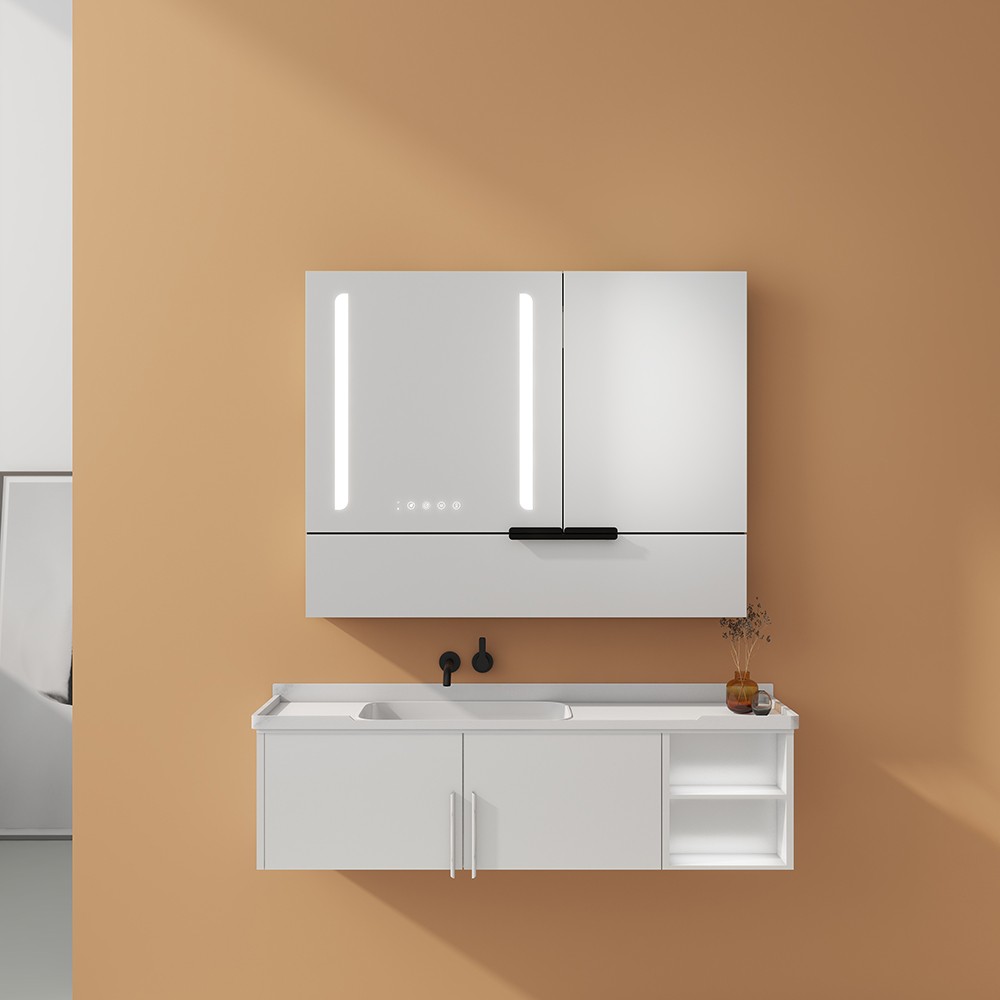
Look at the movement from the side
Use a side view showing the finished wall, cabinet, tap and basin. Mark the panel closed, partly open and fully open. The intermediate positions matter: an edge can pass close to a tap even when the final open position looks clear. Ask for the selected unit’s movement information instead of estimating its path from a lifestyle photograph.
Include the tap handle in the check
Tap clearance includes the handle in use, not just the stationary spout. A tall mixer with a lever on top creates a different arrangement from a wall-mounted spout. Check any handle movement toward the cabinet and the space needed for a hand to operate it. Keep the chosen tap model on the drawing so that a later substitution does not silently change the result.
Leave room for the person using it
Next, put a person in the mock-up. Can they see into the compartment without bending around the panel? Can they remove the intended pouch with one hand while standing normally? Try the movement with a full-size sample or a safe, rigid representation of the panel. A tape outline on the wall helps with position, but it cannot represent a moving edge.
For a bathroom shared by users of different heights, repeat the reach check with those users in mind. Avoid solving a collision simply by lifting the entire cabinet: that may move the storage and mirror away from a comfortable position. The room should work as a whole.
Compare the actual objects below the cabinet
Prepare the vanity exactly as it is expected to be used. Include the soap dispenser, tumbler and any fixed accessories. Temporary styling objects are easy to move for a photograph; permanently placed fittings are not. The following comparison helps identify which part of the layout needs attention.
| Vanity arrangement | What to check | Decision if movement is obstructed |
|---|---|---|
| Tall deck-mounted tap | Panel path and raised handle | Reconsider the tap or cabinet pairing |
| Wall-mounted spout | Projection and hand access | Check the coordinated side view |
| Raised vessel basin | Rim height and retrieval space | Reassess the lower compartment position |
| Accessory tray below | Objects during opening | Assign a clear location for the tray |
A mirror cabinet with flip-down storage is worth comparing when the lower compartment has a clear purpose. Compare the actual layouts, not just photographs of two closed cabinets. If the proposed objects fit only after the tap or tray is moved, make that change explicit before selecting the cabinet.
Do not create a universal minimum gap from this exercise. The required space depends on the specific panel mechanism, fittings and user position. Record the dimensions and configuration you checked so the conclusion can be understood later.
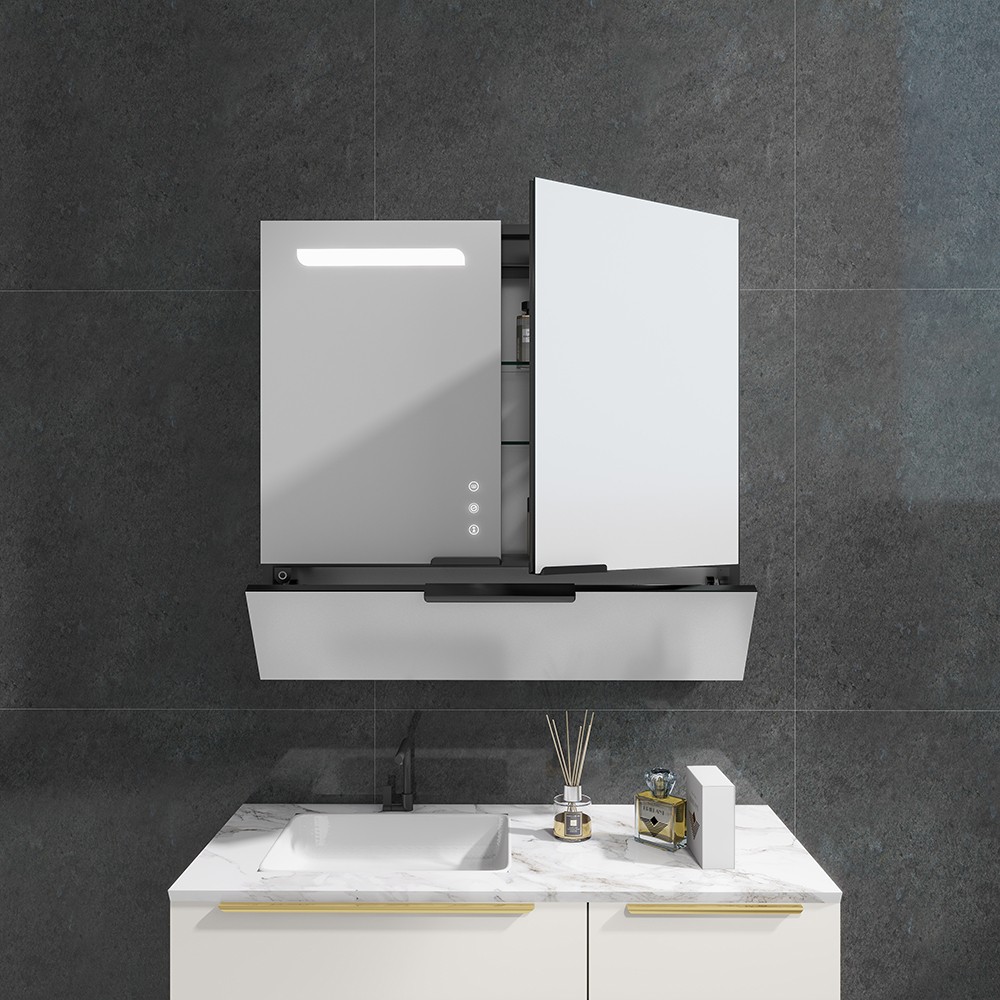
Make the room sample answer one practical question
The room sample should demonstrate a complete storage action. Put the intended items inside, approach the basin, open the lower section, remove an item and return it. Then operate the tap and use the basin with the compartment closed. These are layout observations, not a substitute for the manufacturer’s installation or load instructions.
Keep a short record of the agreed arrangement:
-
Cabinet model and lower compartment configuration.
-
Tap, basin and accessory positions used in the trial.
-
Objects stored and the movement needed to retrieve them.
-
Any layout change required before the room is repeated.
If the arrangement remains cramped, compare another configuration within the bathroom mirror cabinet range. More compartments are not automatically more useful. A simpler cabinet with reachable storage may suit that particular basin better. Preserve the successful room sample as the reference for the remaining bathrooms rather than relying on a general product name.
Summary
Choose the lower compartment only after its movement and everyday use fit the vanity. The decisive evidence is a coordinated side view followed by a realistic retrieval check. Resolve conflicts between the panel, tap and basin before repeating the layout.
Send Eternamir Bath your vanity side view and intended storage items to discuss a suitable cabinet configuration.
FAQ
Can the open panel be used as a shelf?
Only if the selected product’s instructions permit that use. Confirm its intended function and any stated loading conditions before placing items on it.
Is a front view enough to check the fit?
No. Add a side view and check the intermediate positions during opening, together with the tap and basin.
What should be inside the room sample?
Use the actual items intended for the compartment, or accurate equivalents, and the selected vanity accessories. Empty storage does not demonstrate retrieval.
Should I raise the cabinet if the panel meets the tap?
Recheck mirror position and reach before doing so. A different tap, cabinet configuration or overall arrangement may work better.
Does every bathroom need the same lower compartment?
No. Repeat it only where the basin, fittings and user access support the same arrangement. Different room layouts may need a different choice.
