



Wall-Mounted vs Tabletop Makeup Mirrors – Space, Reach, Installation, and Maintenance
Time : October 15, 2026 View : 58
Choosing between a wall mounted makeup mirror and a tabletop mirror is a layout and service decision, not only a style choice. A wall mounted makeup mirror can keep the counter clear and bring the viewing surface closer to the user, while a tabletop unit can move with the routine and avoid fixed construction work. The right answer depends on how much counter space must remain usable, where the user stands, how power reaches the mirror, and how to clean, repair, or replace it.
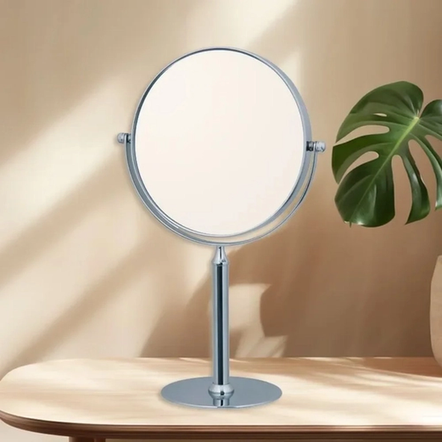
What Changes Between Wall-Mounted and Tabletop Makeup Mirrors?
The first decision is the relationship between the mirror, the user, and the vanity surface. Mounting determines where the mirror can sit, how far it can extend, and whether the same position works for every user or room.
Space, Reach, and Daily Positioning
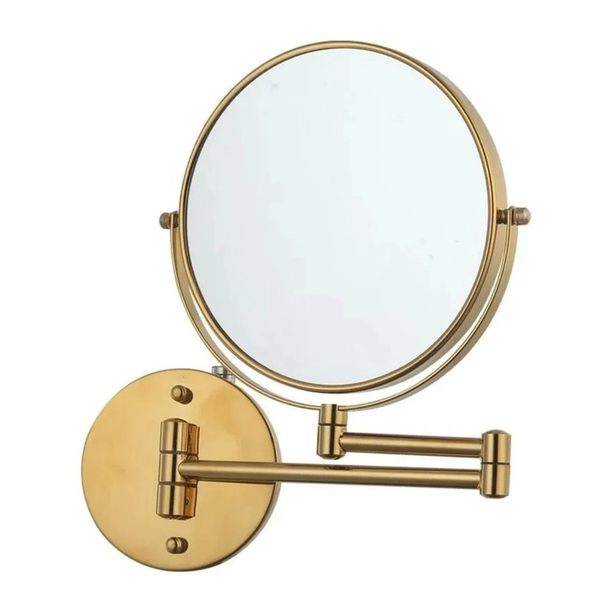
A wall mounted makeup mirror uses the wall area beside or above the vanity, so its base does not occupy a tray or faucet zone. An articulated arm brings the face toward the user and folds back after use. Compact bathrooms and hotel vanities benefit only when both positions clear doors, switches, and adjacent walls.
A tabletop mirror trades saved counter area for placement freedom. A stable base moves between a vanity, dressing table, or shelf without tools.
Portability, Stability, and User Access
Eternamir Bath’s EWM-112 round countertop makeup mirror is a freestanding double-face solid-brass mirror with a stable base, a standard 1x side, and a magnified 3x-5x side. This model can serve full-face checks and close work, but its configuration does not define every tabletop model.
| Decision factor | Wall-mounted configuration | Tabletop configuration |
| Counter space | A wall mounted makeup mirror leaves the surface open after folding | Requires a clear, stable placement area |
| Reach | Depends on arm extension, swivel range, and fixing position | Depends on base placement and viewing angle |
| Relocation | Normally stays with the room | Can move between approved surfaces |
| Construction | Requires wall support and a defined fixing method | Avoids wall fixing but needs a stable surface |
| Power | May use a hardwired route or a specified supply point | May use a model-specific cord or switch arrangement |
Installation Tradeoffs by Project Condition
Installation should be treated as a coordination check rather than a universal step list. The mounting type changes the required drawings, trades, access sequence, and future service path.
Wall Support, Height, and Clearance
For a wall mounted makeup mirror, confirm the substrate, fasteners, weight, fixing plate, and distance from the vanity edge. Height depends on eye level, faucet clearance, arm travel, door swing, and accessibility requirements; no universal number fits every bathroom. Leave room to remove the mirror or arm cover without disturbing adjacent finishes.
Hardwiring, Switching, and Service Access
Power planning separates similar products. The EWM-002A is a wall mounted makeup mirror with hardwired LED lighting, a double arm, a base switch, and 1x/5x sides. The EWM-601 and EWM-602B are freestanding lighted models with 10x magnification and rocker switches. A specification must therefore name the exact model, wiring method, switch location, voltage, and market requirements.
Do not assume that a lighted tabletop unit can use the same outlet or cable path as a wall mounted makeup mirror. Confirm the supply, isolation point, and technician access to the driver or switch. The wall mounted makeup mirror configuration illustrates the reach question; the project drawing must still confirm fixing and electrical details.
Maintenance and Replacement Planning
The mounting choice affects cleaning frequency, access to moving parts, and the cost of a future change. Plan maintenance before purchase so the mirror remains usable when a component needs attention.
Cleaning, Moisture, and Moving Hardware
Both types need a soft cloth and a cleaner compatible with the surface and finish. Keep liquid away from switches, wiring entries, and joints. A wall mounted makeup mirror can collect residue around pivots; a tabletop mirror collects dust beneath its base. The maintenance schedule should name the surfaces to wipe and the faults that require a technician.
In humid rooms, inspect the edge, backing, hardware finish, and wall interface. Eternamir Bath states that mirrors and hardware receive salt-spray testing and that materials are sampled for corrosion-resistant treatment.
Service Access, Parts, and Replacement
A tabletop mirror can usually be removed without opening a wall, which simplifies room changes and replacement of a complete unit. A wall mounted makeup mirror can preserve the room layout for years, but the owner must retain the approved drawing, fastener information, wiring route, and parts list. If the arm, switch, driver, or mirror face changes, verify compatibility before ordering a substitute.
Our pre-shipment inspection includes lighting, high-voltage, and grounding tests, while recurring load-bearing tests are performed on mirror assemblies and repeated when adhesive changes. Use that information to define shipment evidence, while retaining local installation checks and the model-specific service procedure. Record the model reference with the handover documents.
Match the Mounting Type to the Project Brief
Use this sequence before approving a purchase:
1. Draw the occupied counter area, the user’s standing position, and the mirror’s working reach.
2. Decide whether the room benefits more from a clear vanity surface or from a movable unit.
3. Confirm the substrate, fixing method, power route, switch access, and service clearance for the selected model.
4. Review the cleaning method, finish limitations, replacement parts, and handover documents with the operator.
A wall mounted makeup mirror is usually the stronger fit when the counter must remain open, repeatable reach matters, and the wall and power route can be approved early. A tabletop mirror is usually the safer fit when relocation or low-disruption installation matters more. Compare both against the same drawing and maintenance checklist. The Eternamir Bath makeup mirror range is a starting point for matching its product architecture to the brief.
FAQ
Q: Is a wall mounted makeup mirror better for a small bathroom?
A: When a small vanity needs all of its usable depth, a wall mounted makeup mirror has one clear advantage: the base stays off the counter, and the arm folds away after use. It is not automatically better: confirm wall support, movement clearance, switch access, and service space. A tabletop unit may work better when the room needs relocation or has no approved fixing point.
Q: What is the difference between a wall mounted makeup mirror and a countertop makeup mirror?
A: A wall mounted makeup mirror is fixed to the room and gets its reach from an arm or swivel joint. A countertop makeup mirror rests on a stable surface and gets flexibility from relocation and repositioning. Compare occupied counter area, working distance, power arrangement, cleaning access, and replacement process rather than treating mounting style as a quality ranking.
Q: Does a countertop lighted makeup mirror need hardwiring?
A: Not necessarily. A countertop lighted makeup mirror may use a model-specific cord and switch, while a wall-mounted lighted configuration may be hardwired. The product specification must identify the supply method, voltage, switch, isolation point, and destination-market requirements. Never infer the wiring arrangement from “lighted”; confirm it for the exact model before installation.
Q: How should a wall mounted makeup mirror be cleaned and serviced?
A: Use the approved soft-cloth method for the glass and finish. Keep liquid away from switches and joints, and inspect the arm, fixing area, edge, and backing for residue or damage. Keep the model drawing, wiring details, and parts list available. If a fixing loosens, the glass is damaged, or an electrical fault appears, call a qualified technician instead of dismantling the unit.
Q: Is a countertop makeup mirror easier to move or replace?
A: A tabletop unit is generally easier to move because it is not tied to a wall fixing or concealed supply route. A wall mounted makeup mirror can be easier to keep consistent across rooms, but replacement depends on compatible fixing dimensions, arm reach, wiring, and finish. Compare complete removal and reinstallation work, not only mirror weight.
