



Mirror Cabinet Showroom Displays That Help Buyers Compare
Time : November 17, 2026 View : 14
A mirror cabinet showroom display should let buyers answer three practical questions: how the cabinet looks closed, what becomes accessible when it opens, and which features belong to the unit they would order. Plan the display around those comparisons. A wall filled with illuminated mirrors may attract attention, but customers still need room to open doors, see the storage and connect the sample to a clearly identified configuration.
Give each display a reason to be there
Choose a small group of cabinets that answer different customer needs. One might demonstrate a compact interior; another might show wider two-door access; a third could introduce a separate lower compartment. Write the reason for each selection before arranging the wall. Several nearly identical units need a clear explanation of what buyers should compare.
For an Eternamir Bath selection, review the bathroom mirror cabinet collection and identify the differences your customers ask about. Keep the chosen models within a coherent display: a wall about storage access should make that feature easy to explore. Avoid filling every space with an unrelated option simply because a sample is available.
A useful starting exercise is to write one sentence beside each proposed unit: “This sample helps the buyer decide…” If the sentence repeats the purpose of its neighbour, consider whether both units are needed. The display can still offer several finishes through clearly labelled samples without repeating a full cabinet for every colour.
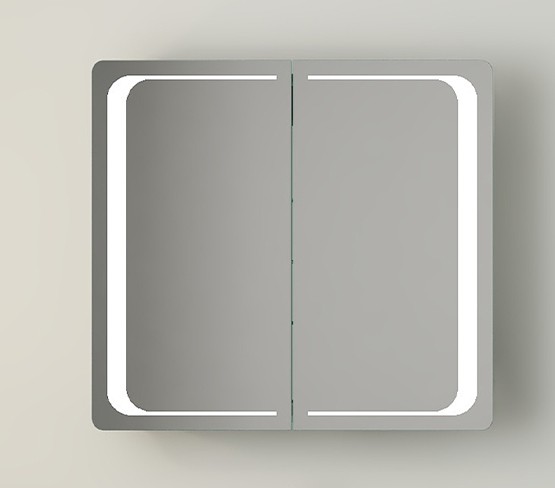
Let people see the closed and open cabinet
The closed view establishes the mirror’s outline, door divisions and lighting appearance. The open view explains the storage. Give each its own viewing moment. A cabinet held permanently open makes its interior visible but can obscure the appearance that first interested the buyer.
Stand where a customer would naturally approach the display. Can they see the whole cabinet without backing into another visitor? Can they reach the handle or intended opening point? Check the arrangement with neighbouring doors open as well. Floor-space planning should include these real movements, not just the width of each closed unit.
Position loose brochures and accessories outside that movement area. If the display includes a vanity, keep the surface representative of a usable bathroom. Too many decorative objects can hide the very clearance the customer came to understand. An accessible display should follow the premises’ relevant requirements; a pleasing wall elevation alone cannot establish that.
Show storage without hiding the details
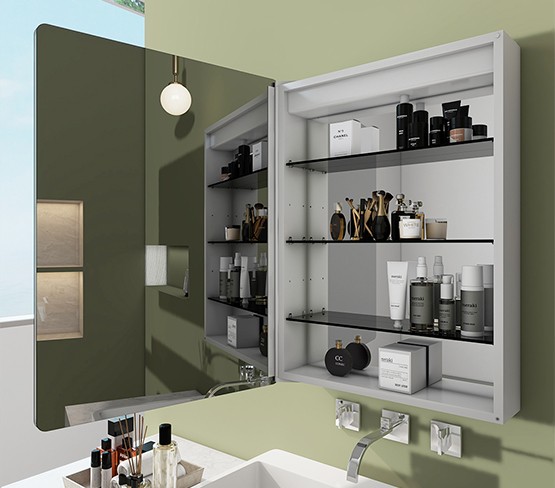
Use a few ordinary containers to show scale, leaving enough empty space to see the shelves and inner surfaces. Avoid fitting every shelf with matching ornaments. Buyers need to judge how their own items might sit inside, and a densely dressed sample makes that harder.
A two-door mirror cabinet can demonstrate interior access when both doors are opened in turn. Label the exact displayed configuration. Do not let a demonstrator’s description of one sample become an assurance that every size or option has the same interior layout.
Make the comparison understandable without a salesperson
Use short labels that identify the model, displayed size and features included in that sample. Separate included features from options that require a different order. A buyer should be able to photograph the label and later connect it to the unit they tried.
| Buyer question | What the display should reveal | Label information |
|---|---|---|
| What am I looking at? | Complete closed front | Model and displayed dimensions |
| What can I reach? | Open interior with sparse contents | Door arrangement and shelf configuration |
| What does this control do? | One clearly demonstrated action | Function fitted to this sample |
| What would I order? | Sample linked to a specification | Included features and separate options |
Keep unconfirmed claims off the labels. Terms such as “all finishes available” or “fits any bathroom” can create an expectation that the sample does not establish. Where an option needs confirmation, say what the customer should confirm. Precise wording is more useful than a long string of promotional badges.
For fair visual comparisons, avoid giving one unit a dramatically brighter surrounding display than its neighbours. If the showroom uses different room settings intentionally, explain that difference. Customers should understand when they are comparing a cabinet feature and when they are reacting to the surrounding design.
Rehearse one short customer demonstration
Plan a sequence that staff can repeat without turning the visit into a technical presentation. Begin with the closed mirror, open the storage, show one relevant feature and finish by identifying the displayed specification. Let the customer’s own question determine which feature deserves more time.
For a mirror cabinet with concealed door wiring, the open view can help explain the interior arrangement. Show the assembled cabinet as intended; do not remove electrical covers as part of an ordinary sales demonstration. Any powered display needs an installation suitable for the premises and selected product.
Reset the sample between visits
Give staff a simple reset routine between demonstrations:
-
Return loose containers to their agreed positions.
-
Close doors so the next visitor sees the complete front.
-
Restore the agreed lighting state for comparison.
-
Confirm that the model label still matches the sample.
When a sample changes, update its label and demonstration notes together. Keep the order reference available behind the display or in the sales system. A beautiful presentation loses its practical value if the eventual quotation describes a different size, door layout or set of functions.
Summary
An effective display connects appearance, access and the orderable configuration. Choose samples with distinct purposes, leave space for normal use and keep labels specific. The result should help buyers compare cabinets and leave with a clear record of the unit they preferred.
Send Eternamir Bath your proposed display selection to discuss the models and configurations before preparing the showroom labels.
FAQ
How many cabinets should a showroom display include?
Use the number needed to show meaningful differences within the available space. There is no fixed count that suits every showroom.
Should cabinet doors stay open all day?
Let customers see both conditions. Resetting the closed front after a demonstration preserves the appearance for the next visitor.
Can decorative bottles demonstrate storage capacity?
They can show scale, but a styled arrangement does not establish maximum capacity or shelf loading. Keep those claims separate.
What belongs on the display label?
Identify the exact model, displayed dimensions and included features. Distinguish any optional configuration so the buyer can ask for the right unit.
Should every lighting option be demonstrated at once?
Show one relevant action at a time. Keep the comparison clear, and identify which controls and options belong to each sample.
