



How to Choose the Best Bathroom Cabinet with Outlet for Small Bathrooms
Time : September 23, 2026 View : 32
A small bathroom is often short on three kinds of space at once: counter space, charging space, and usable wall space. A Bathroom Cabinet with Outlet addresses the problem by combining a mirror, vertical storage, and a controlled charging zone on the vanity wall. The best choice still depends on mounting method, size, outlet placement, storage, and installation planning.
Why a Bathroom Cabinet with Outlet Works in a Small Bathroom
The main advantage is not simply having one more socket. It is concentrating functions that would otherwise compete for the same wall and counter area. Toiletries leave the countertop, toothbrush or shaver chargers move into a contained zone, and a separate mirror and cabinet no longer need separate positions.
This creates both physical and visual space. A vertical cabinet uses eye-level wall area for daily items, while hidden cords and closed doors reduce visual noise. The internal layout matters as much as the outside dimensions: usable capacity depends on the toiletries and devices that the household actually uses.
For a quick comparison of space-saving medicine-cabinet approaches, see 5 Best Medicine Cabinets for Small Bathrooms in 2026 to Maximize Storage and Style. The same principle applies here: make the vanity wall work harder before adding furniture to the floor.
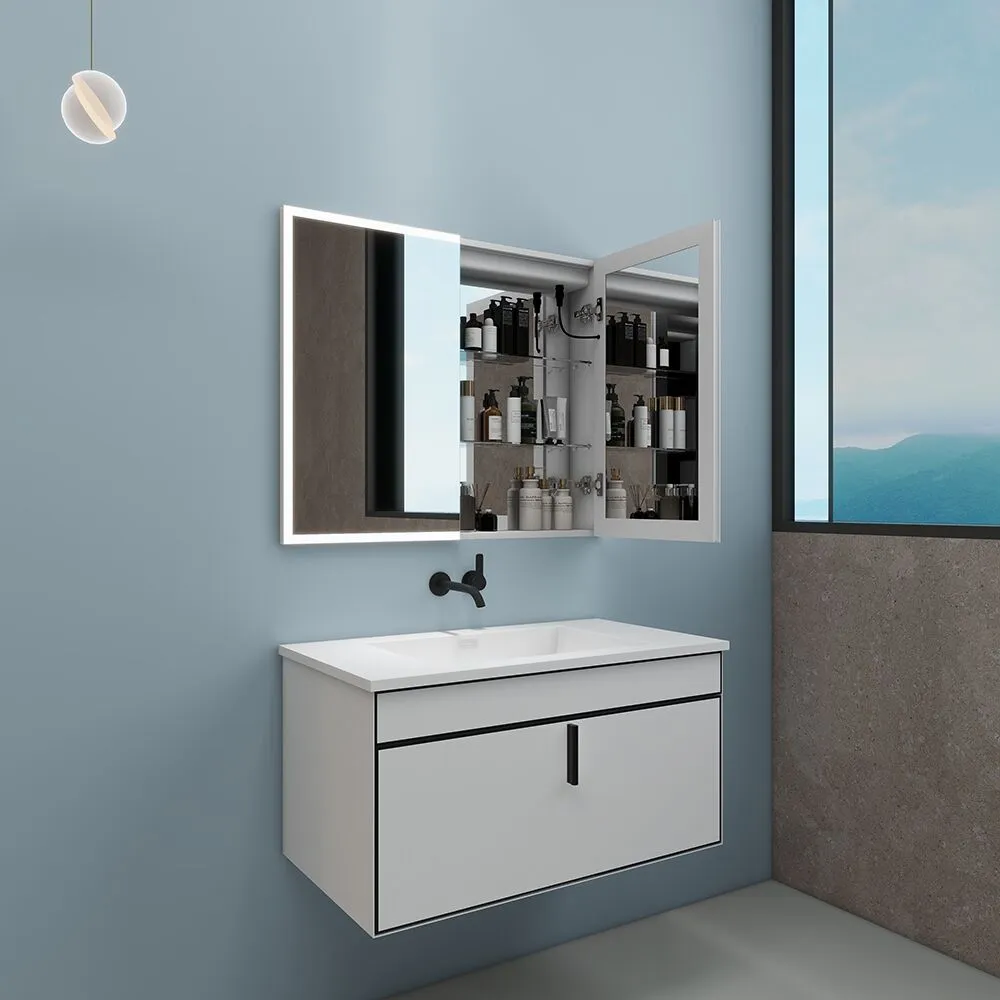
Recessed or Surface Mount: Which Cabinet Fits the Wall?
A recessed medicine cabinet with outlet places most of the body inside the wall cavity. That reduces projection and preserves walking clearance beside a narrow vanity or tight passage. It is easiest to plan during renovation or new construction, when the wall opening and power entry can be coordinated before finishes are installed.
Recessed installation should never be assumed to fit every wall. Check studs, pipes, existing wiring, vents, cavity depth, and waterproofing constraints. The cabinet also needs enough depth for shelves, adapters, and cable bends without sacrificing storage.
A surface mount medicine cabinet projects farther into the room, but it avoids opening the wall and can suit older bathrooms or walls with services inside. Compare actual projection rather than rejecting surface mounting automatically. A shallow cabinet, clean mirror front, concealed wiring, and vertical form can still create efficient small bathroom storage.
Door movement matters too. A single-door or narrow arrangement may reduce the opening path near a side wall, light fixture, shower glass, or tall faucet. For a product example related to recessed planning, review the Stainless Steel Cabinet for Recessed Mount Medicine Cabinet.
How to Choose the Right Bathroom Cabinet with Outlet Size
Do not measure only the available wall width. Use four dimensions:
• Width: Match the vanity, faucet centerline, side walls, and nearby fixtures.
• Height: Check the user sightline, sconce or light position, backsplash, and shower-glass relationship.
• Depth or projection: Allow enough interior volume without narrowing the passage or colliding with a person at the sink.
• Door-opening clearance: Measure the full swing, handle reach, shelf access, and any collision with a wall or fitting.
Before choosing shelf positions, measure the items that will live inside the cabinet: the tallest skincare bottle, toothbrush charging base, shaver, plug, and adapter. A built-in outlet bathroom cabinet loses storage value if the socket occupies the only shelf area tall enough for daily products.
Available mirror-cabinet configurations can include one, two, or three doors, adjustable tempered-glass shelves, and custom sizes. In a narrow room, vertical storage and controlled door swing are often more useful than simply making the cabinet wider.
Where Should the Outlet Go Inside the Cabinet?
Start with the devices that will actually be connected. Electric toothbrushes, shavers, trimmers, and rechargeable grooming devices may need different plug orientations and clearance. The outlet should let the door close, keep the adapter away from the shelf edge, and prevent the cord from crossing a hinge.
An internal outlet creates a hidden charging zone, but hidden does not mean suitable for every appliance. Some documented cabinet configurations offer hardwired or three-pin-plug wiring and an outlet socket. The exact configuration and local electrical requirements still need to be confirmed, including voltage, outlet type, rated load, and destination market.
Do not assume that a cabinet electrical outlet can power a hair dryer or other high-wattage appliance simply because the plug fits. Check the rated load and intended use for the selected model. An outlet, USB port, shaver socket, and wireless charger are different configurations, not interchangeable labels.
For more context on placing power inside bathroom storage, see Why Install a Bathroom Cabinet with an Outlet? Top Use Cases. The useful test is simple: can the device charge without taking over the countertop or blocking the cabinet’s most useful storage?
Bathroom Cabinet with Outlet Safety and Installation Checks
Bathroom conditions add moisture, condensation, grounding, and circuit-protection concerns. Confirm that the exact cabinet configuration suits the intended damp location and that outlet rating, wiring method, and documentation align with the destination market. Local electrical code and professional verification remain necessary.
Installation planning should cover power-entry position, recessed opening, cabinet centerline, mounting surface, service access, and the relationship to the vanity and mirror. Decide early between hardwire and plug-based options. Waiting until the cabinet reaches the site can force changes to finished walls.
Material and durability checks matter in a humid room. Corrosion resistance should be considered across the mirror, cabinet body, hardware, screws, and related parts. For powered or lighted configurations, buyers can ask how electrical components are aged and inspected. Documented checks may include aging tests for LED strips, drivers, and touch switches, plus shipment inspection covering lighting, high-voltage, and grounding.
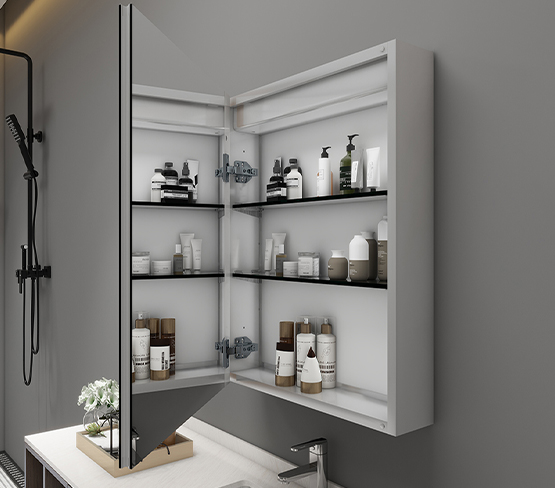
Which Features Actually Improve Small Bathroom Storage?
Choose features by asking one question: does this remove another object from the room or make storage easier to use?
Adjustable shelves are valuable when bottle heights vary. An integrated mirror removes the need for a separate reflective surface. Integrated task lighting can support face-level grooming, but it should not automatically be treated as the only ambient room light. Brightness and color temperature are separate choices, so check both.
A defogger can help when steam makes the mirror difficult to use after a shower, but its operation and availability should be confirmed for the selected model. Controls, wiring, driver access, and repair information deserve the same attention as finish.
The goal is a clutter-free bathroom vanity, not the longest feature list. A smart bathroom cabinet can become a centralized grooming station when its mirror, storage, lighting, supported power, and controls match the household routine. Eternamir Bath provides mirror and mirror-cabinet solutions for residential and hospitality applications and supports customized design, so the specification can begin with room measurements and daily routine. We can review the cabinet size, mounting preference, storage layout, outlet configuration, and destination-market requirements together.
FAQ
Q: Is a Bathroom Cabinet with Outlet a good choice for a small bathroom?
A: Yes, when it combines mirror, vertical storage, and supported charging in one vanity-wall zone without reducing door clearance or usable shelf space.
Q: Is a recessed medicine cabinet with outlet better than a surface-mount model?
A: Recessed mounting reduces projection when the wall cavity allows it. Surface mounting may be better when opening the wall is impractical or services occupy the cavity.
Q: Can a bathroom cabinet with built-in outlet charge an electric toothbrush or shaver?
A: It may, subject to the selected outlet configuration, plug type, voltage, rated load, adapter clearance, and local electrical requirements.
Q: Can a Bathroom Cabinet with Outlet power a hair dryer?
A: Do not assume so. Hair dryers are high-wattage appliances; check the exact rated load and intended use before connecting one.
Q: Does installing a Bathroom Cabinet with Outlet require an electrician?
A: Professional verification is appropriate for hardwired or electrically integrated cabinets. Confirm the mounting, rough-in, grounding, protection, and local code before installation.
