



How Does a Fog-Free Bathroom Mirror Work, and When Is It Useful?
Time : November 04, 2026 View : 48

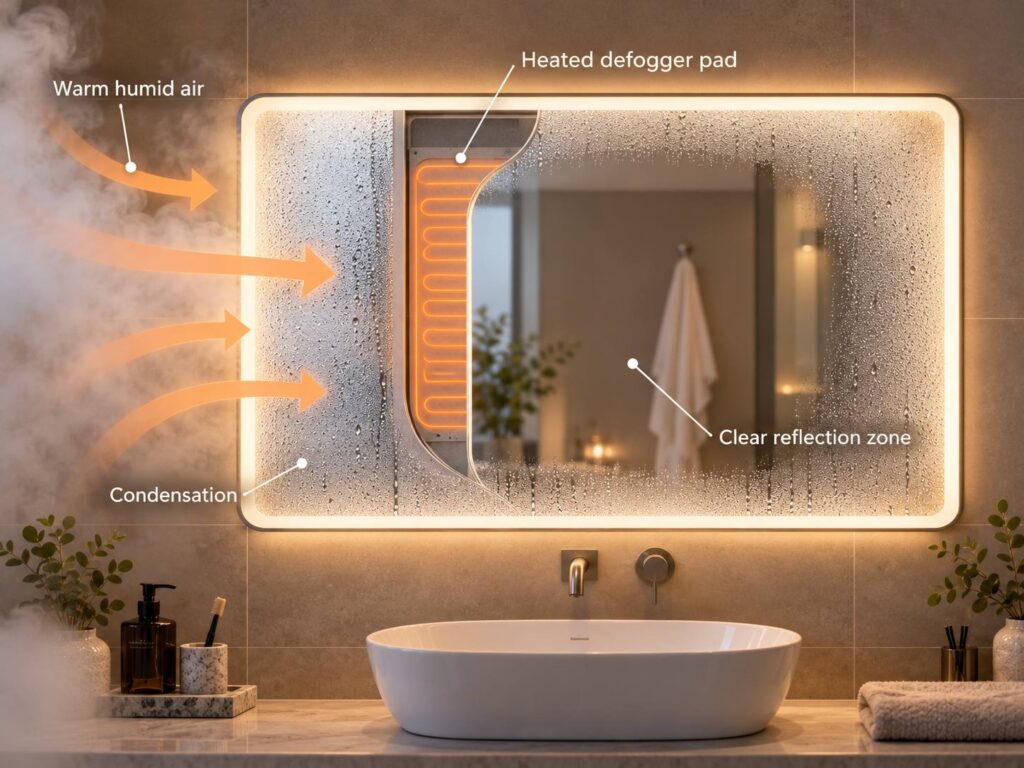
If your morning routine involves wiping the mirror and waiting for it to mist up again, I’d put a defogger on the shortlist. It heats the glass from behind, so the warmed area is less prone to condensation. There is a catch worth understanding before you buy: it won’t dry out the bathroom. I’d still want a working exhaust arrangement.
What I’d want from the mirror is quite modest: a usable reflection when I step up to the basin. I’d judge the ventilation by what is happening around the rest of the room, including damp towels and wet surfaces. Being able to see my face again wouldn’t persuade me to ignore those.
Why does shower steam obscure a mirror?
Why does the cloth only help briefly? You’re removing the droplets, but the glass may still be cooler than the warm air beside it. More water can condense there. A scattering of tiny droplets is enough to make the reflection hazy; you don’t need water running down the whole surface. I’d look at that temperature difference before blaming the mirror finish.
The heater addresses that cool surface by warming the glass from behind. What I would ask for is the heater outline on the mirror drawing. Then I could mark my own standing position against it. I’d be rather disappointed to order a wide mirror and discover that the only clear area was too far to one side for the basin layout.
For a shared wide mirror, I’d mark both standing positions on the drawing. One heated area might suit the way the bathroom is used; it might also leave one person peering over the other’s shoulder. This is a layout question I’d settle with the drawing and sample before ordering.
What should you ask about a mirror defogger?
Eternamir Bath offers a defogger as an additional function on selected mirrors. For a mirror under consideration, ask the supplier to identify the proposed option on the order and show its heated area on a dimensioned drawing.
Then try the control. you’d begin by finding out whether switching the light on also starts the heater. If the light is switched off, what happens to the heating? I wouldn’t infer either answer from the symbol on a touch button. You need the operating sequence for the configuration being offered.
Timing deserves a practical trial as well. If the instructions call for switching the heater on before use, try that routine rather than waiting until the glass is fully misted and expecting an instant result. Ask what behavior to expect, and use the selected product’s instructions when testing it. Warm-up and coverage shouldn’t be guessed from the phrase “fog free.”
For a guest bathroom, I would let someone unfamiliar with the unit try the controls. Resist explaining them immediately. If a guest can’t find the function, the hotel may need a different arrangement or clearer operating information. That is easier to settle with a sample than after the rooms have been handed over.
Why keep checking the ventilation?
Picture stepping out of a shower to a clear mirror while the towels and tiles remain wet. The mirror heater hasn’t failed simply because the room is still damp; it was never doing the exhaust fan’s job.
Include a fan and duct check in the renovation work. The US Environmental Protection Agency makes a useful distinction in its bathroom renovation guidance: a running fan needs to exhaust sufficient air outdoors, not merely make a noise. I’d want that checked even if I was pleased with the new mirror’s defogging.
If the room still felt persistently damp, I would have that investigated. I wouldn’t change my view just because the mirror had a clear center. The fan, duct and wider building arrangements would still deserve attention.
What needs to be settled before installation?
For installation, take the electrical and mounting drawing to a qualified installer while the wall is still accessible. Where will the connection go, and how will someone reach it for service? On a replacement job, I’d show them what is already there and ask which parts, if any, can be retained. I wouldn’t make that decision from the fact that the old mirror happened to be illuminated too.
Suppose a crescent of mist remains after you’ve used the function. I’d compare that shape with the heater drawing and check the instructions before deciding something had gone wrong. Perhaps the mist is outside the heated area; perhaps the behavior needs a service review. A photograph and a description of when it appeared would give the service person something to work with. Leave any electrical investigation to someone qualified.
Keep the supplied care instructions beside the cleaning products until the routine was familiar. Before adding an anti-fog spray, please ask whether it is compatible with this mirror. A product meant for another surface isn’t automatically a good idea here, and don’t try scraping or modifying the glass to improve the result.
You can start with the bathroom mirror range, but please make the final choice with the drawing and operating instructions open beside the quotation. Also, keep the installer’s comments with them. That way, when the unit arrives, there is a clear record of the arrangement everyone agreed to.
FAQ
Q:Will a fog-free bathroom mirror remove humidity?
No. I’d expect a clearer reflection from the warmed area, rather than drier air. If towels stay damp or the room takes a long time to dry, I would have the ventilation checked instead of asking the mirror heater to deal with it.
Q:Does a defogger clear the entire bathroom mirror?
I wouldn’t assume so. I’d ask the supplier to mark the heated area on the proposed unit’s drawing and compare it with where I stand. That is especially useful when two people will use a broad mirror at the same time.
Q:Should the mirror defogger turn on with the light?
I’d choose that after trying the sample. If you only want light while brushing your teeth, independent operation might appeal. Ask what is available for the proposed unit, and try turning the power off and back on as part of the review.
