



How Deep Should a Medicine Cabinet with Lights Be Storage Space Explained
Time : October 21, 2026 View : 54
When it comes to choosing the right depth for a medicine cabinet with lights, you need to consider the depth of the usable shelf space for your bathroom items plus the depth for the construction and lighting design chosen. The depth of a bathroom and of items on display will dictate the optimal depth for a seemingly deep cabinet and for a recessed storage space. Items to be stored in the cabinet plus the available space in your bathroom for the installation of the cabinet must be measured and considered when choosing the depth.
Which cabinet depth are you actually measuring?
Outside depth versus clear shelf depth
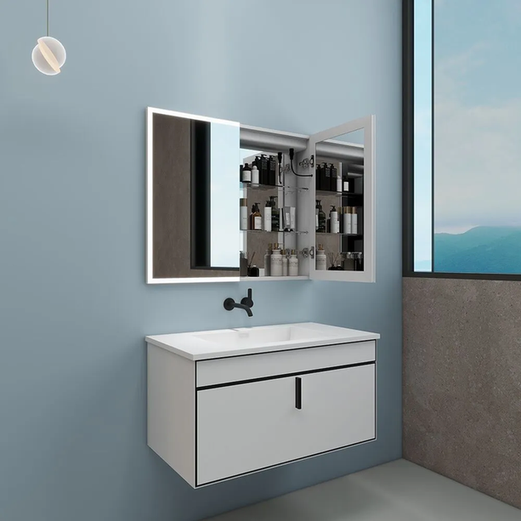
Separate three measurements: overall depth from the back to the frontmost closed surface, usable shelf depth inside the cabinet, and projection beyond the finished wall. They answer different questions. Overall depth affects installation; shelf depth determines whether items fit; projection affects head clearance and the room’s appearance.
Projection beyond the finished wall
The usable capacity of a storage cabinet depends on the internal layout and the type of toiletries you have in your home. A large outside dimension does not automatically mean large storage capacity. In addition to the door, mirror, and back panel, the hinges, the setback of the shelf, and the compartments for electrical articles occupy space that cannot be used by bottles, etc.
Request a section drawing with the door shut. Measure the narrowest storage area, not the widest empty corner. If there is an internal power point, check the space with a plug and cable connected. The advertised size of a storage area is never as good as an actual clearance check in the intended configuration. The actual usable capacity will depend upon how you intend to use the space and what you intend to store in the bathroom of the users of the household.
How do you calculate the shelf depth you need?
Measure the actual toiletries
For your daily routine, gather all the items that you normally use in the morning, such as toothbrush holder, cleanser, shaving gear, makeup, etc., plus any approved electrical item. Measure the front-to-back width of each item at its widest point, including any handles and pump actions. Place the items upright in the configuration that you anticipate using.
Organize shelves around tall and small items
Ensure sufficient clearance around pump heads and caps. Check fit with cabinet door closed.
While adjustable shelves can be useful in mitigating height conflicts, they are of little use in resolving problems of insufficient front-to-back depth. These cabinets are offered in one-, two-, and three-door configurations and include adjustable tempered-glass shelves. Importantly, cabinets can also be offered in a variety of custom sizes. However, usable capacity will always be a function of the actual internal organization and the storing of a household’s toiletries, etc. Thus, tall bottles, small jars, and frequently used items, for example, would be best stored in separate zones of depth.
Eternamir Bath is happy to supply mirrors and also custom-designed mirror-cabinets for residential and hospitality clients. In addition to the standard range of fixed-height mirror-cabinets with one or more adjustable tempered-glass shelves, we are able to supply cabinets of custom dimensions to fit around specific objects to be stored rather than filling out a deep cabinet to fill out the space.
How much space do lights, drivers, and wiring occupy?
Locate lighting and driver compartments
Incorporating a lit medicine cabinet into a storage area with electrical parts can prove effective, but the front light strip may have little impact on that particular shelf. The same could be said for the driver’s compartment, cable route, switch housing, or even a socket, and so the impact of the light can vary depending on its location.
Account for plugs and cable clearance
There are documented cabinet configurations that have been set up with hardwired or three-pin-plug wiring and an outlet socket. Moving supported power points into the storage area can assist in keeping the countertops free from clutter, depending on the individual configuration and local requirements. Plug, cable bend, and service access must all be considered when deciding what to store against these features.
A smart medicine cabinet mirror can serve as a centralized grooming station when its mirror, storage, lighting, supported power, and controls match the household routine. This is a planning framework, not a promise that every cabinet includes every function. Avoid sacrificing usable shelf space for features that the household will not use.
Check driver access, glare, and controls before ordering.
When considering the LED Bathroom Mirror Cabinet With 2 Different Size Doors, request the section drawing and the electrical compartment arrangement for the chosen order. Confirm usable depth without interpreting width and height listings as depth specifications.
How do surface and recessed mounting change clearance?
Check surface projection above the basin
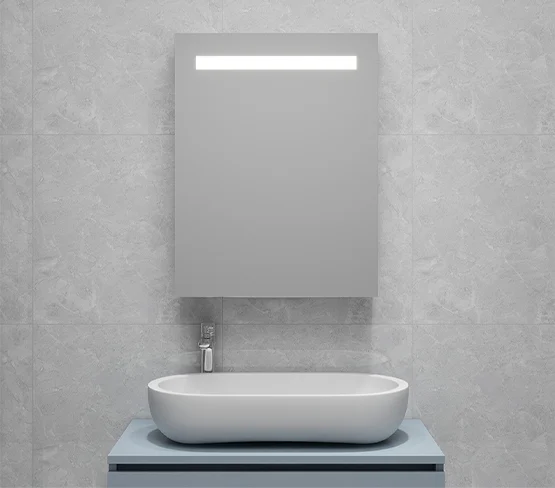
By mounting cabinets to the wall surface, they project out from the wall. So, check the front of the cabinet projecting out from the wall to see where it will be in relation to where you will be standing at the vanity, leaning forward. Check for clearance to operate the faucet and for the open door to not get in the way of a light, wall, or adjacent cabinet.
Verify the recessed wall cavity
Although a recessed mounting option is available which places part of the body in the wall, this does not mean that the corresponding cavity automatically is suitable for installation. The available depth, the construction of the walls, any pipes, cables, etc., and possibly also any special fire or moisture protection requirements all have to be checked by the installer before cutting into the walls. Installation instructions and services must be checked first.
Single, double, and sliding-door forms should be selected on the basis of the available wall space. The door layout affects both use-value and appearance. A wide door requires a different opening area than two narrow doors, and wider cabinets do not automatically result in deeper shelves.
Compare mounting forms within the bathroom cabinet collection before finalizing the wall opening. A compatible mounting method must be confirmed for the actual cabinet, not inferred from another model’s photographs.
What should you confirm before ordering cabinet depth?
Prepare a dimensional schedule
This would be a short list that outlines the overall dimensions of the cabinet and then goes into greater detail about the usable shelf space, maximum projection on the wall, door swing, typical item heights, and electrical requirements. A simple sketch would be far more useful than a long description of a deep cabinet without context.
Confirm shelf supports and door clearance
Check the shelf supports and the door clearance with a list of representative articles. Although the two-size-door LED cabinet shown here is equipped with soft-close hinges, adjustable tempered-glass shelves and plastic shelf clips, the information provided here about the storage will not explain the limits of the usable depth and the load capacity of the selected configuration. These must be obtained separately.
Use technical support to resolve missing dimensions and driver access before ordering. If the everyday items fit comfortably, a shallower cabinet may be preferable to unnecessary projection. If they do not fit, consider a different layout or custom dimensions rather than storing objects sideways and blocking the door.
FAQ
Q: Is a deeper medicine cabinet with lights always better for storage?
A: No. It is the usable shelf depth and the internal layout of the items that matter more than the overall depth. Extra projection may make the basin less comfortable to use but gives no benefit.
Q: How do I measure usable medicine cabinet depth?
A: Measure the clear front-to-back shelf area with the door closed to account for hinge intrusion, shelf setback, electrical compartments, and any plug or cable connected to the electrical compartments.
Q: Do LED lights always reduce medicine cabinet storage depth?
A: No, the impact of illuminated cabinets depends on how the strips, drivers, wire, and controls are arranged. Ask for a drawing of the actual layout as opposed to being misled by an assumption that every cabinet loses the same amount of space.
Q: Can a recessed medicine cabinet fit into any bathroom wall?
No. Check the available cavity depth, the surrounding framing, services, etc., and the installation requirements of the item to be installed before making a decision as to how best to form the opening and what can be cut.
Q: Can adjustable shelves compensate for a shallow medicine cabinet?
A: Cabinets can be organized up and down but will not add depth to a front-to-back wall of cabinets. Measure the widest item and select a cabinet that will hold that item with the door closed.
