



Dimmable LED Medicine Cabinets: Are Adjustable Lights Really Worth It?
Time : August 12, 2026 View : 100
A dimming control sounds useful, but will you adjust it every day or stop touching it after the first week? The answer depends less on the feature label than on your routine, the quality of the light, and the bathroom’s wider lighting plan. Dimmable LED medicine cabinets can make detailed grooming and late-night visits more comfortable, yet a poor dimming range or uneven light may add cost without adding much value. The practical question is whether the cabinet provides the right light, at the right level, when your bathroom routine changes.
What Do Dimmable LED Medicine Cabinets Actually Let You Adjust?
How Is Brightness Dimming Different from Switching the Light On and Off?
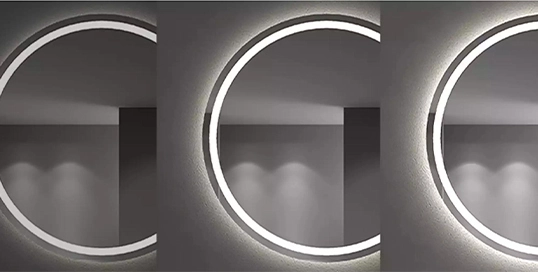
An on/off switch gives two states; dimming changes output between them. Brightness controls light output; color temperature changes the light’s warm-to-cool appearance. These controls should be evaluated separately because one does not guarantee the other. Eternamir Bath documents them separately; in our catalog, a long press adjusts brightness or color temperature, with 20%, 50%, and 100% shown as brightness examples. Those are examples, not universal settings.
How Is Dimming Different from Adjustable Color Temperature?
Color temperature changes whether white light looks warm, neutral, or cool; it does not necessarily make it brighter. A cabinet may offer dimming, selectable tones, or both. Eternamir Bath’s source material states that color temperatures from 2700K to 6000K can be provided, while the Single Door Lighted Mirror Cabinet is a current model to check for its exact controls. Never assume every lighting mode combines both adjustments.
When Do Dimmable LED Medicine Cabinets Improve Everyday Bathroom Routines?
The supplied material links sufficient brightness with completing makeup and dressing, and it describes selecting different brightness or color-temperature settings at different times of day. Adjustment is most useful when one mirror serves several routines.
How Does Adjustable Lighting Help with Morning Grooming?
Morning daylight changes with weather and season. A controllable cabinet can brighten a dim face without forcing maximum output when sunlight is strong.
Brighter Light for Shaving and Detail Work
Shaving and other close work benefit from clear edges and small details. A higher setting can reveal missed spots, provided the illuminated area is broad and does not create sharp reflections.
Neutral Light for Makeup and Skin-Tone Checks
For makeup, even coverage and color rendering matter alongside brightness. Eternamir Bath’s material says it uses LEDs with CRI 90+; confirm that for the exact model. A neutral tone can help check colors without a strong cast.
How Does Lower Brightness Help at Night?
A low setting can provide orientation and mirror visibility without the abrupt glare of full grooming output during a quick night visit.
Softer Light for Evening Skincare
Evening skincare needs visibility, but not always precision-work intensity. Dimming can keep product coverage and the sink visible at a softer level; this is a comfort choice, not a medical claim.
Reduced Glare During Late-Night Bathroom Visits
Lower output can reduce reflected glare. The low end must remain stable: a setting that flickers, switches off abruptly, or leaves the face patchy is not useful.
Why Is Adjustable Lighting Useful in Shared Bathrooms?
Shared bathrooms rarely have one preferred setting. Dimming lets different users choose detail light, daylight support, or low night output without changing permanent fixtures.
Can Dimmable LED Medicine Cabinets Replace Separate Vanity Lights?
What Can Face-Level Lighting Do Better Than Ceiling Lighting?
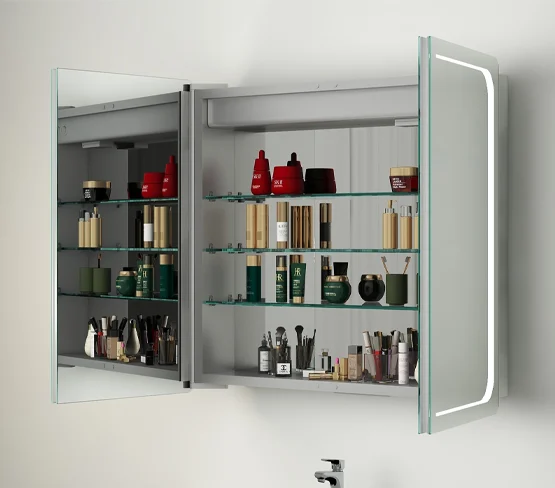
Ceiling light can create shadows beneath the brow, nose, and chin. Mirror-level light reaches the face closer to eye level. The product material describes integrated cabinet lighting as useful for cosmetics and as a source of bathroom light. A Halo Lighted Medicine Cabinet illustrates perimeter lighting, although its exact output still needs model-level review.
When Can the Cabinet Serve as the Main Grooming Light?
A cabinet can be the main grooming light when it covers the face evenly at normal standing distance without glare. Test it with other lights on and off; a narrow bright border can still leave shadows.
When Is Layered Bathroom Lighting Still Necessary?
Face-level task lighting and whole-room ambient lighting do different jobs. A cabinet may handle shaving or makeup but leave the shower, floor, or doorway underlit. Larger or deeper rooms still need ambient light. It may replace a grooming fixture, but it should replace room lighting only when the full space remains evenly illuminated.
What Are the Drawbacks of Dimmable LED Medicine Cabinets?
What Happens If the LED Driver or Controls Fail?
Integrated lighting adds serviceable parts. One documented configuration lists a 50,000-hour LED lifetime and a 30,000-hour LED-driver lifetime. It offers hardwired or three-pin-plug wiring and lists 0-10V dimming, TRIAC dimming, and touch dimming on the mirror as available functions. “LED life” is therefore not the whole maintenance story; ask whether the driver and control are accessible and replaceable.
Why Do Some Cabinets Flicker or Dim Unevenly?
Flicker can result from mismatched drivers and wall dimmers, poor connections, or uneven LED distribution. The pros and cons of LED medicine cabinets are better judged through the electrical design than brightness claims alone. Our quality statement says acquired LED strips, LED drivers, and touch sensor switches undergo at least 72 hours of aging testing. Testing matters, but it cannot promise that a component will never fail.
Does Installation Become More Complicated?
Hardwired power, compatible wall controls, recessed mounting, or extra circuits may require coordination before the wall is closed. Plug-in surface mounting can be simpler, but local electrical and damp-location rules still apply. Confirm wiring, service access, and installer responsibilities.
Who Should Choose Dimmable LED Medicine Cabinets – and Who May Not Need Them?
Which Users Benefit Most from Adjustable Bathroom Lighting?
Adjustable output is most relevant when one mirror supports different tasks or users, when daylight changes markedly, or when lower output is useful at night. Frequent makeup, shaving, shared schedules, and glare concerns give the control a clear job.
When Is a Fixed-Light Cabinet Good Enough?
A fixed-light cabinet can be sufficient when the routine is consistent, vanity lighting already handles grooming, or simple controls are the priority. If users always choose one level, prioritize even distribution and suitable output instead.
How Can You Decide Whether Dimmable LED Medicine Cabinets Are Worth It?
Does the Light Stay Useful at Both Low and High Settings?
Try the full range. The low setting should stay stable; the high setting should reveal detail without painful glare. Check whether adjustment is continuous or stepped, and do not judge only the showroom level.
Does the Mirror Light the Face Evenly Without Harsh Glare?
Stand at your normal grooming distance. Look for facial shadows, bright reflected points, and unequal left-right coverage. Cabinet width and diffuser quality may matter more than a headline lumen number.
Do the Available Light Tones Match Your Daily Routine?
Confirm whether dimming and color-temperature adjustment are independent, whether the model has the expected CRI and range, and whether every user understands the controls. Extra tones add little if switching is awkward.
Are Installation, Controls, and Future Repairs Clearly Explained?
Ask for the wiring method, compatible dimmers, driver location, replacement procedure, and warranty boundaries. Evaluate the usable low and high settings, face illumination, glare, available color tones, control method, wiring plan, driver access, and repair explanation. The best evidence is the specification and operating behavior of the exact cabinet, not the word “dimmable” in a product title. Clear answers that fit your routine make the feature worth considering; vague answers do not.
FAQ
Q: Are dimmable LED medicine cabinets worth it for everyday use?
A: Yes, when you use different levels for grooming, daylight changes, shared routines, or night visits. If one setting suits every task, fixed light may offer better value.
Q: Do dimmable LED medicine cabinets provide enough light for makeup?
A: They can, but check face coverage, useful output, glare, CRI, and surrounding light. Dimming alone does not guarantee shadow-free makeup lighting.
Q: Can dimmable LED medicine cabinets replace bathroom vanity lights?
A: They may replace a separate face-level grooming light. They do not automatically replace ambient lighting needed for the shower, floor, doorway, and the rest of the room.
Q: How long do dimmable LED medicine cabinets usually last?
A: Lifetimes vary by LEDs, driver, controls, heat, and use. One documented configuration lists 50,000 hours for LEDs and 30,000 hours for its driver, so check component terms.
Q: Do dimmable LED medicine cabinets need to be hardwired?
A: Many are hardwired, especially recessed or wall-controlled models, but some configurations offer a three-pin plug. Confirm the exact model, local electrical requirements, and dimmer compatibility before installation.
