



Aluminum Cabinet for Bathrooms: How to Choose the Right Medicine Cabinet
Time : August 06, 2026 View : 132
An aluminum cabinet may look suitable in a catalog, but project buyers must consider more than appearance. Will it resist bathroom humidity, remain aligned after repeated use, fit the wall structure, and perform consistently across dozens or hundreds of rooms?
For distributors, developers, designers, and bathroom brands, a medicine cabinet combines storage, mirrors, hardware, lighting, and installation requirements. This guide explains how to evaluate one from material selection to supplier qualification.
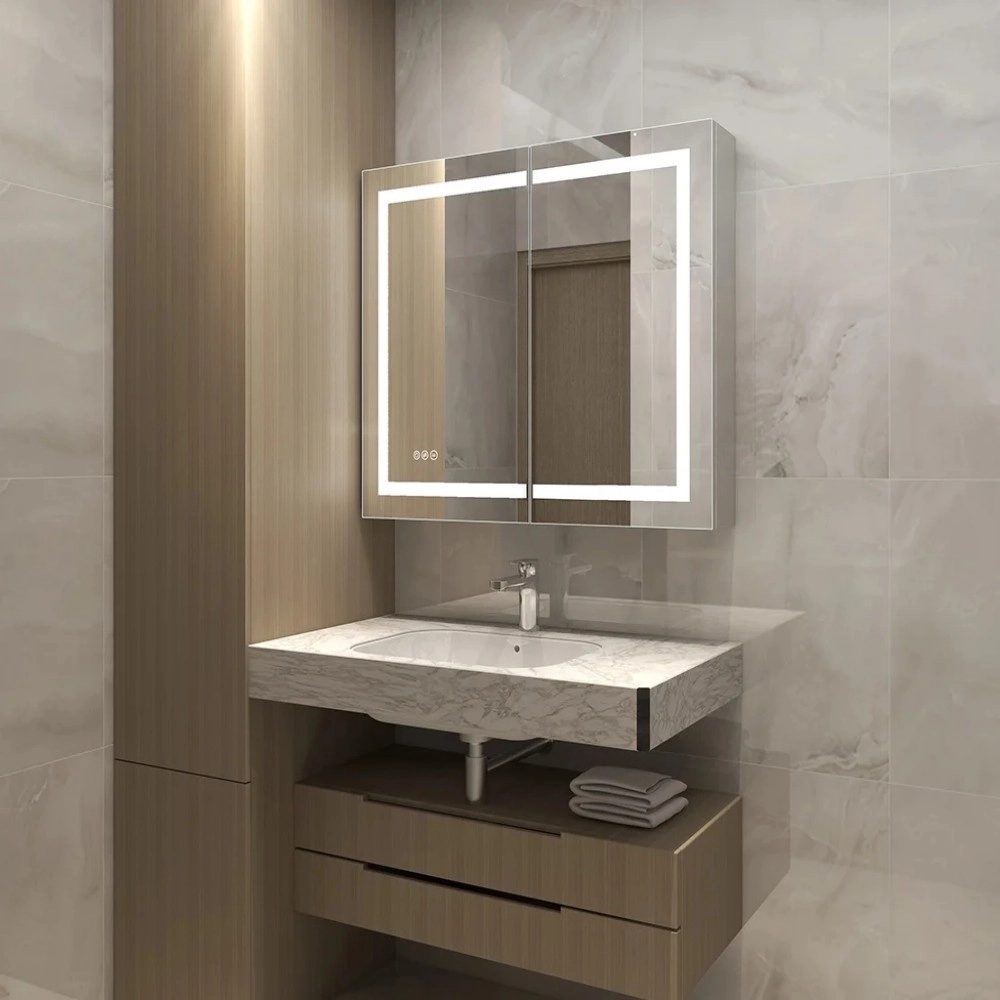
Why Aluminum Cabinet Specification Matters in Bathroom Projects
The Hidden Costs of Choosing the Wrong Bathroom Cabinet
Purchase price is only one part of project cost. A poorly specified cabinet can lead to corroded fasteners, loose hinges, damaged mirror edges, uneven doors, electrical failure, and installation rework.
In multiroom developments, correcting one repeated defect can disrupt schedules, raise labor costs, and create warranty claims.
A sound specification should cover:
1.Bathroom humidity and cleaning conditions
2.Wall structure and installation depth
3.Expected use and storage load
4.Electrical and safety requirements
5.Batch consistency and after-sales support
Why Aluminum Works Well in Humid and High-Use Bathrooms
Aluminum weighs very little. It holds its shape well over time. It also fights off standard iron rust. Wood boards absorb water and swell up in damp bathrooms. Aluminum completely avoids this exact problem. The lighter weight makes moving the boxes much easier. It also speeds up the wall mounting process. This helps a lot when you hang wide two-door or three-door models.
Just seeing the word “aluminum” does not mean the product is great. Buyers must look closely at the metal thickness. They need to check the corner joints and the surface paint. It is also important to test the hardware fit. Make sure the screws and small metal parts will not rust.
A well-engineered aluminum medicine cabinet therefore suits hotels, apartments, villas, and residential programs requiring dependable storage.
What Makes a High-Quality Aluminum Bathroom Cabinet?
Aluminum Body, Frame Construction, and Surface Finish
The main body must feel solid when you open the doors. The frame needs to stay perfectly square under everyday weight. Wide cabinets require extra support. This prevents the mirrored doors, hinges, and glass shelves from bending the metal frame.
Surface treatment affects durability and design. Matte silver coordinates with common fixtures, while black, grey, and custom finishes suit different interiors.
During sample review, check for smooth joints, protected edges, consistent door gaps, stable hinge points, an even finish, and suitable fasteners. These details often reveal more about production quality than product photography.
Mirror, Hinges, Shelves, and Interior Hardware
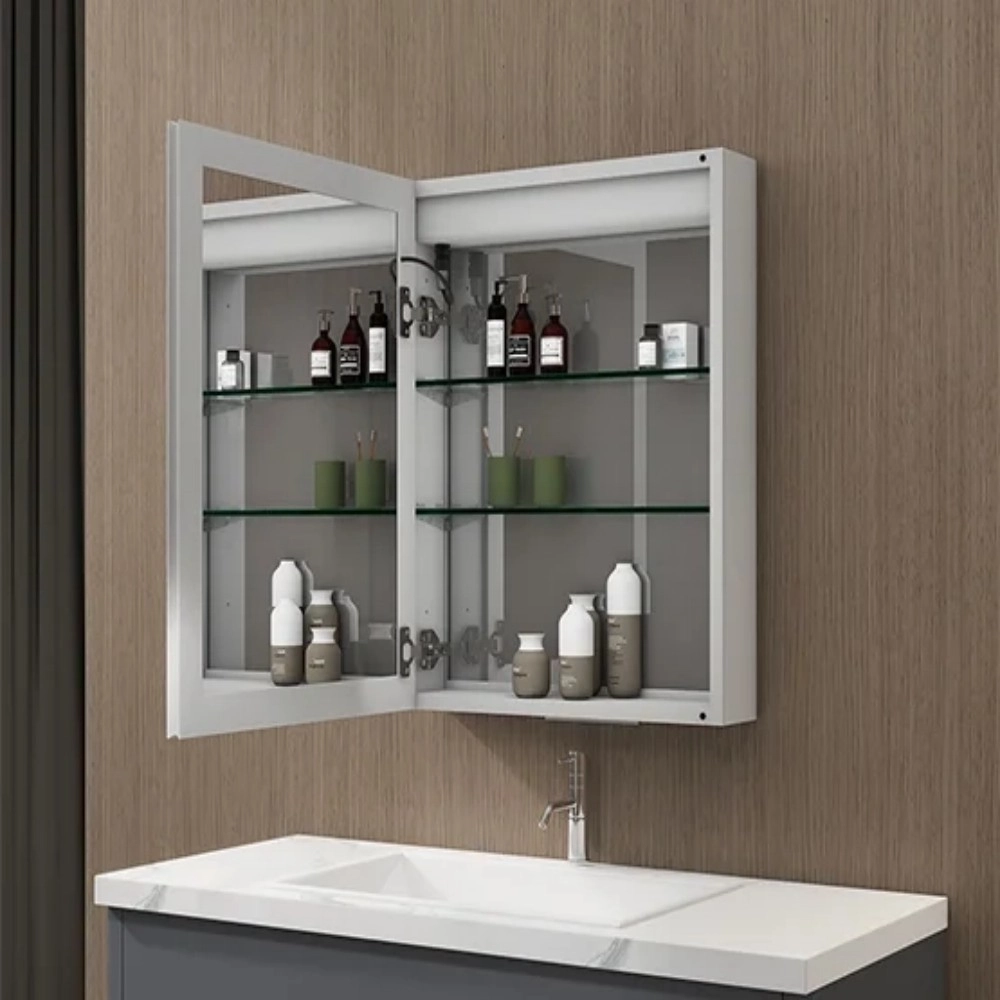
Cabinet performance depends on the complete system, not only the aluminum shell. Mirror safety, hinge control, shelf strength, and internal fittings all affect daily use.
Eternamir Bath offers aluminum medicine cabinet configurations with 3 mm double-sided copper-free mirrors, safety backing, soft-close hinges, and adjustable tempered-glass shelves. Selected surface-mounted models offer one, two, or three doors, left- or right-opening arrangements, several finishes, and standard or customized sizes.
Selection should begin with the room plan. A compact bathroom may need one door, a hotel vanity may benefit from two, and larger shared spaces may require three-door mirror coverage.
The internal layout also deserves attention. Adjustable shelves allow users to organize bottles and personal-care items of different heights. Shelf clips should hold the tempered glass securely, while door widths should provide convenient access without interfering with nearby walls, lighting fixtures, or faucets.
LED Lighting, Defogging, and Electrical Safety
For a lighted aluminum mirror cabinet, evaluate color temperature, color rendering, lumen output, driver life, wiring, controls, and certification.
High color rendering helps skin tones and finishes appear natural. Depending on the model and project specification, available functions may include touch dimming, 0–10V dimming, TRIAC dimming, night light, defogger, digital clock, Bluetooth speaker, or outlet socket. Features should match the application rather than being added automatically.
A hotel may prioritize reliable hardwiring and simple controls, while a premium residential collection may require dimming or defogging. Selecting only the necessary functions can control costs and reduce future maintenance complexity.
Electrical parts need aging tests, while completed units should undergo lighting, high-voltage, and grounding checks. Mirror safety backing and secure bonding are also important because they help control glass fragments if breakage occurs.
Which Aluminum Medicine Cabinet Mounting Type Fits Your Project?
Surface-Mount Aluminum Medicine Cabinets
A surface-mounted cabinet attaches directly to the finished wall. It is practical for renovations, solid walls, shallow partitions, and projects where opening the wall would increase labor.
Because the body sits outside the wall, this format can maximize storage depth. Confirm projection, mounting strength, cable access, and vanity alignment.
Surface mounting makes future replacements much easier. The workers do not have to cut a perfect hole in the drywall. However, you must watch the cabinet depth closely. It should match the sink bowl and the water faucet. If it sticks out too far, it looks bulky and blocks the user.
Recessed Aluminum Medicine Cabinets
A recessed cabinet sits partly or fully inside the wall cavity, creating a flatter appearance. It works best in new construction, where framing and wiring can be planned before the wall is closed.
Before ordering, confirm:
1.Wall cavity depth
2.Framing positions
3.Plumbing and electrical routes
4.Required clearances
5.Finished opening dimensions
Approved drawings are essential because an incorrect opening can delay installation or require wall modification. The installation team should also confirm whether additional framing is needed to support the cabinet and mirrored doors.
Dual-Mount Cabinets for Flexible Project Installation
Dual-mount models support surface or recessed installation when designed for both conditions. This flexibility is useful in developments with different wall types but a consistent bathroom design.
Guest rooms may have framed walls while public washrooms use solid construction. One compatible family can reduce SKU complexity.
Eternamir Bath provides surface-and-recessed models with copper-free mirrors, safety backing, rust-resistant matte silver aluminum bodies, soft-close hinges, and hardwire options. Buyers should confirm the exact trim, mounting accessories, and electrical arrangement for each selected model.
How Does Aluminum Compare with Other Bathroom Cabinet Materials?
Aluminum vs. Stainless Steel Medicine Cabinets
Both materials perform well when properly specified, but they serve different priorities.
|
Factor |
Aluminum cabinet |
Stainless steel cabinet |
|
Weight |
Lighter |
Usually heavier |
|
Installation |
Easier to handle on wide units |
May need stronger support |
|
Corrosion |
Does not develop iron rust |
Strong resistance with a suitable grade |
|
Finish |
Flexible coated or custom finishes |
Often chosen for a metallic appearance |
|
Best fit |
Hotels, apartments, and residential programs |
High-impact or specification-led projects |
Aluminum often suits projects focused on weight, customization, and installation efficiency. Stainless steel may be preferable where rigidity or impact resistance is the main concern.
The final decision should consider the cabinet size, mounting surface, project budget, desired finish, and expected frequency of use rather than relying on material reputation alone.
Aluminum vs. Steel, Wood, and MDF Cabinets
Basic cheap steel is strong. However, a tiny scratch in the paint lets bad rust start quickly. Bare wood or cheap MDF boards soak up water fast. Their edges will swell up and break apart.
An aluminum body avoids that swelling risk and supports slim, modern profiles. Still, buyers must compare the entire product. Good mirrors, hinges, shelves, fasteners, and testing matter as much as the cabinet material.
How Should B2B Buyers Evaluate an Aluminum Cabinet Manufacturer?

Customization, Quality Control, and Project Consistency
A capable manufacturer should convert a design brief into a repeatable production standard. Buyers should review five areas:
1.Dimensions, doors, finish, mounting, wiring, and functions
2.Drawings and physical sample approval
3.Testing of mirrors, hardware, aluminum parts, and electronics
4.Market certificates, packaging, and shipment inspection
5.Lead time, warranty, and replacement-part support
At Eternamir Bath, we support hospitality and residential mirror-cabinet projects through OEM and ODM development. Our quality process includes ISO 9001:2015 management, at least 72 hours of aging tests for acquired electrical parts, corrosion-resistance sampling, and full inspection before shipment.
Finished-product checks can include lighting, high-voltage, grounding, and drop testing where applicable. We also support multiple international certification requirements and provide a three-year product warranty.
The real test is reproducing approved dimensions, finish, light output, door alignment, and packaging across the full order. Buyers can send us the required size, mounting method, finish, functions, certification market, and quantity for a project-specific recommendation.
FAQ
Q: Is an aluminum cabinet suitable for a humid bathroom?
A: Yes. A properly made aluminum bathroom cabinet resists iron rust and does not swell like moisture-sensitive board. Buyers should still check the finish, fasteners, mirror protection, hardware, and overall construction.
Q: Does an aluminum bathroom cabinet rust?
A: Aluminum does not rust like iron or ordinary steel. Poor finishing, unsuitable fasteners, chemical exposure, or weak fabrication can still cause oxidation, staining, or surface damage.
Q: Is an aluminum medicine cabinet better than a stainless steel medicine cabinet?
A: It depends on the project. Aluminum is lighter and often easier to customize and install. Stainless steel can offer greater rigidity. Consider the wall structure, cabinet size, design, budget, and expected usage.
Q: What should buyers check when choosing an aluminum cabinet manufacturer?
A: Buyers should review customization capability, material specifications, mirror safety, hinges, shelves, electrical testing, certifications, sample approval, production consistency, packaging, lead time, warranty, and relevant project experience.
