



Aluminium Medicine Cabinet Durability and Corrosion Resistance Guide
Time : October 28, 2026 View : 32
An aluminum medicine cabinet can work well in humid bathrooms. But more than the body needs close review. Focus also on the finish. Check the fittings. And review the installation method. Aluminum forms a protective layer of oxide. Yet this does not mean the material is indestructible. Trapped moisture can harm it. Strong cleaning agents may cause damage. Exposed edges create risks. Poor fixing points lead to trouble as well. It is therefore essential to examine the complete cabinet. Do not look only at the body. This approach helps assess its durability.
Why does aluminum resist ordinary corrosion?
Understand the protective oxide film
The protective oxide layer on aluminum helps shield the metal underneath from corrosion. Aluminum does not develop red rust like iron. Even so, it can still experience corrosion. Attack, discoloration, and damage can occur. These issues appear in local areas. They affect surfaces and joints too. Thus, the absence of red rust alone does not provide an adequate check on its condition.
Distinguish humidity from direct wetting
Humidity in the bathroom at typical levels does not represent a continuous spray application, wet condition, or leaking bottle of cleaner kept in a cabinet. The true exposure should be evaluated where it actually exists. A cabinet in an area of ventilation such as a vanity will be easier to maintain than a cabinet near an open shower.
How do finishes, edges, and joints affect durability?
Inspect coating coverage and joints
The value of a coating or anodized finish depends on adequate coverage and a good quality finish for the intended exposure. Check lower corners, folded edges, screw holes, and joints for any signs of water or cleaner residue, and local damage that may have gone unnoticed.
Choose an approved finish repair
Many people make the wrong assumption that all scratches have to be sanded down and refinished. Exposed edges, chips in the finish, and scratches are three separate issues and require different methods. It is essential to determine whether the existing finish is fixable and what is the approved procedure for doing so by the manufacturer. The wrong type of refinishing on a scratch can actually cause the removal of more protective surface area than was damaged before.
Bathroom humid environments require special attention to corrosion resistance. The inspection needs to cover the entire assembly from the mirror at the top of the cabinet down to the bottom of the box, including hardware, screws, and all other parts. A seemingly solid cabinet body can hide a darkening of the mirror’s edge, a staining of a screw or other fastener, and a very difficult-to-move hinge.
Which hardware details should you check?
Assess mixed metals and fasteners
While many aluminum bodies use other materials for hardware, the presence of such hardware is not necessarily a deficiency. However, wet contact between metals can create a corrosion issue. Inquire about the selection of fasteners and hinges, and whether they require isolation, etc., in the assembly.
Check hinge loading and storage fittings
Inspect attachment points for looseness, chipped surface finish, and presence of standing water. A heavier door will place repeated loads on hinges and associated supports. Assess corrosion resistance and mechanical durability together – a fitting must remain secure and operate correctly and not just look clean.
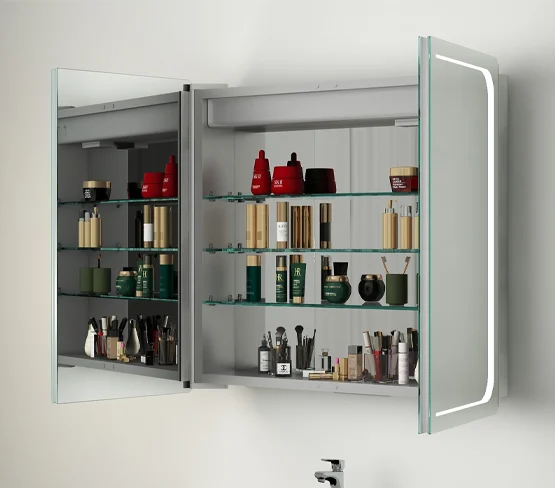
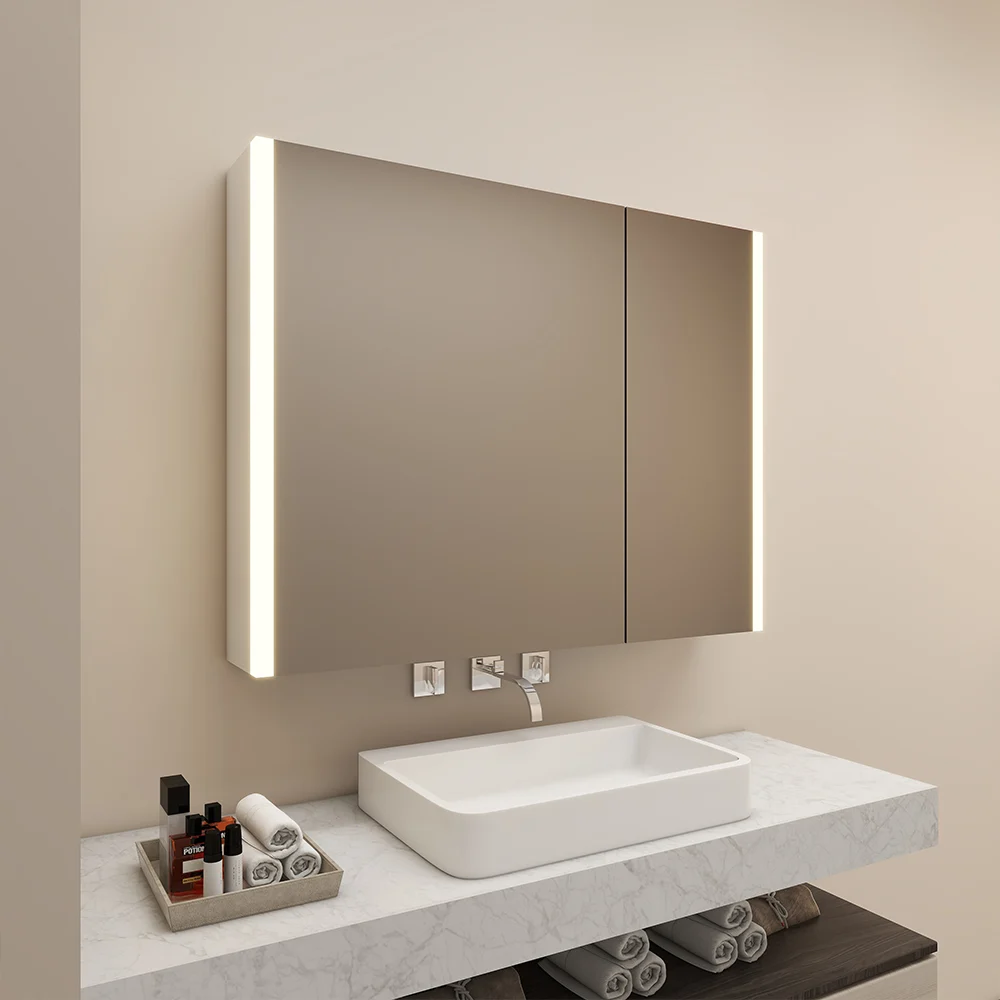
Eternamir Bath provides mirror and mirror-cabinet solutions for residential and hospitality applications and supports customized design. Our LED Bathroom Mirror Cabinet With 2 Different Size Doors uses a rust-resistant aluminum cabinet body and is suitable for bathroom damp-location use. This is a specification for that cabinet, not a declaration that every aluminum cabinet is suitable for every wet location.
The documented LED cabinet utilizes a 3mm double-sided copper-free mirror with safety backing. This is a separate specification from the aluminum body for the mirror construction and the safety backing.
The soft close hinges, adjustable tempered glass shelves, and plastic shelf supports are some of the characteristics associated with the opening and closing of the cabinet. It would be wrong to confuse these characteristics with the unmentioned hinge life, shelf weight capacity, or anti-corrosion characteristics of the cabinet. For more information on the particular characteristics needed for your installation, please contact the supplier. The cabinet can be ordered in one-, two-, or three-door designs with adjustable tempered-glass shelves. It can also be customized to different sizes.
What evidence should support an aluminum cabinet purchase?
Request material and location specifications
Request the body material, finish, mounting method, fitting materials, maintenance instructions, and intended location classification. For illuminated models, obtain the selected electrical configuration and installation requirements as well. A damp-location description does not replace the local rules that govern electrical installation near water.
Verify the scope of corrosion tests
Salt spray testing of mirrors and hardware for corrosion resistance, and aging testing of electrical parts for service life are two examples of testing. Make sure that the reports cover the components of interest. Reports of testing of mirrors and hardware for corrosion resistance do not constitute a guarantee for the entire cabinet for the entire lifetime, and hours of exposure in testing laboratories should not be confused with years of bathroom use.
Compare construction and mounting arrangements in the medicine cabinet collection without assuming identical materials across the range. Confirm materials and performance in the order specification.
How do installation and cleaning extend cabinet life?
Install with the required fixings and clearance
The cabinet must be installed using the manufacturer’s fixings and the recommended clearances. Check that the door is able to open and shut freely and that all the shelves and clips are fixed securely. It is essential that a cabinet is not located in a constant spray area unless the manufacturer states that it is safe to do so.
Remove spills and avoid abrasive cleaners
Clean any detergent spills on the cabinet body immediately. Do not allow it to soak into the surface. For normal cleaning of the cabinet body, use a soft cloth and avoid the use of metal wire, scouring pads, etc and any strong chemicals. Also protect the cabinet from any hard impacts or scratches. Do not place any sharp objects or those with rough bottoms directly on the cabinet surface.
Store liquids upright in sealed bottles. It is important not to place a wet cloth on the bottom of the panels. When cleaning, it is important to look for any leaks or condensation on the lower seams, edge mirrors, hinge plates, and screws. Instead of continually cleaning an area that keeps building up moisture, it is better to locate and solve the problem.
FAQ
Q: Can an aluminium medicine cabinet corrode?
A: Yes. Aluminum resists most normal exposures during regular use. Yet it can still develop corrosion in specific spots. It can also suffer damage to the surface. Trapped moisture often leads to trouble. Wrong cleaners create further issues. Joint damage causes problems as well. These remain the common areas of concern.
Q: Does aluminum rust like steel in a bathroom cabinet?
Aluminum does not make red rust the way iron does. But it can break down from other corrosion processes. So look at the surface instead. Check the fittings. Examine the connections for any signs of decay. Do not search only for red marks.
Q: Is an aluminum medicine cabinet safe beside a shower?
A: Check the requirements for the exact position of your cabinet. Review the related rules for electrical installation too. A rating for damp locations only does not allow continuous spraying. It does not permit placement anywhere near water.
Q: How should an aluminium medicine cabinet be cleaned?
A: Take a soft cloth. Pick a cleaner that suits the finish. Clean any spill right away. Dry all moisture at once. Do not use rough cleaners. Avoid harsh chemicals. Only apply them if the manufacturer has given approval.
Q: Does salt spray testing guarantee an aluminum medicine cabinet’s lifespan?
A: No. The test results cover only the parts tested. They relate to the conditions listed for the test. Examine the full extent of the test. Look at the acceptance standards that match it. A basic report on the mirror or the hardware does not provide a set service life for the complete cabinet.
Examine the body. Look over the finish. Inspect the fittings. Review the installation. Consider all of them together as one complete assembly.
